A month in a $600 LED mask taught me almost nothing
I spent a month inside an LED face mask to find out whether the science holds up to the marketing. Between the $109 Kahlia Skin and the $690 4D Pro, here is what you are actually paying for.

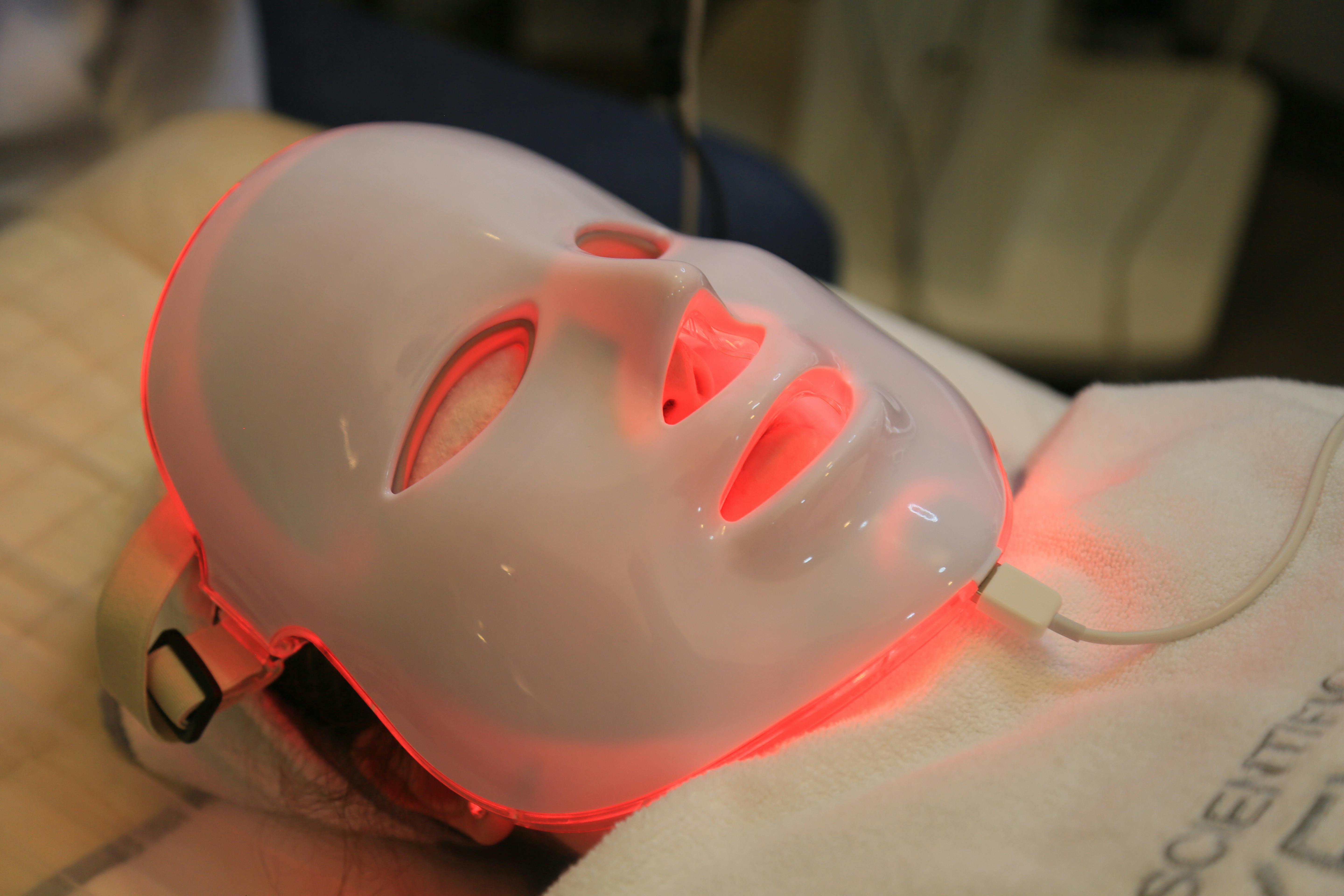
The first time I strapped an LED face mask to my head, I looked like a cyborg who’d given up halfway through a facial. The mask sat heavy on my nose, the velcro caught in my hair, and the red glow made my bathroom look like a darkroom. My partner walked in, said nothing, and walked out again.
I have been testing three of these masks for the past month. Not because I believe the marketing. I spent enough years on the brand side of beauty to know how a $12 cost of goods becomes a $695 “investment piece.” The reason I bothered is that the dermatologists I trust kept using the same phrase: “there’s real science here.” Rachel Reynolds, interim chair of dermatology at Harvard’s Beth Israel Deaconess Medical Center, told me she started out thinking LED therapy was “just the latest fad to get people to spend their money.” Then she read the literature. She changed her mind. That pattern (sceptic reads evidence, sceptic softens) repeated across every researcher I spoke to.
So I wanted to know: if the science is real, why does the marketing feel so fake? And at what point does a device stop being a considered purchase and start being a $700 hope tax?
I was surprised to find the mechanism isn’t pseudoscience. LED light therapy (the technical term is photobiomodulation, PBM) was discovered by accident in the 1960s. A Hungarian physician named Endre Mester shaved a mouse and pointed a low-power red laser at its skin. He was testing for tumours. Instead, the mouse grew hair faster. Its wounds healed quicker than the controls. Sixty years later, researchers at McGill and UCLA have mapped out what happens at the cellular level: red and near-infrared light hit the mitochondria and set off a chain reaction. ATP (cellular energy) and nitric oxide (blood flow) spike. Collagen follows. Inflammation drops. It is a real effect. You can measure it. It depends on dose.
Here is the part the product pages skip. Wavelength determines penetration depth. Red light at 630 to 660 nanometres reaches the dermis. That is where your fibroblasts live, the cells that pump out collagen and elastin. Near-infrared at 810 to 880 nanometres punches deeper, into the subcutaneous layer. It hits blood vessels and deeper tissue. Blue light at 415 nanometres barely clears the epidermis, which, if you are acne-prone, is exactly where P. acnes bacteria set up camp. Each wavelength is a tool for a different depth. The job changes with the depth.
Blue light works differently from red in a way that matters if you are acne-prone. It activates toxic free radicals in the skin’s surface layers that kill P. acnes bacteria over several days. It does not suppress sebum production or unclog pores. What it does is kill the bacteria that inflame the clog. Glynis Ablon, a UCLA dermatologist, told National Geographic she sees “dramatic effects” in her acne patients from blue light alone. “Their acne gets better, the level of inflammatory lesions reduces, their overall skin just starts to look better.”
But here is where the asterisk goes, and it is a big one. Ablon also said something else: “There’s a lot of scams out there. Most of the time, energies are very, very low.” She looks for devices emitting at least 105 milliwatts per square centimetre for red light. For blue, she’ll accept 40. At 10 mW/cm², she says, the device “is probably not doing anything.” Ten milliwatts is not a hypothetical. A lot of the sub-$150 masks on Amazon sit right around there. You are strapping a toy to your face.
I thought about this a lot while scrolling through the product pages. The language is identical across brands: “glowing,” “radiant,” “rejuvenated,” “professional-grade.” The before-and-after photos are lit differently. The celebrity endorsements (Bella Hadid for Omnilux, Chrissy Teigen, Jessica Alba) are everywhere. The prices in Australia currently range from $109 for the Kahlia Skin wireless mask at Adore Beauty to $690 for the 4D Pro Ultimate at The Skincare Tools, with most of the dermatologist-recommended options clustering between $499 and $680. That is real money. That is a plane ticket to Bali. That is six months of prescription retinoid.
Kahlia Skin, the $109 option, is Australian-owned and sells through Adore Beauty. It has blue, red, and yellow LEDs and no eye protection. At the other end, the CurrentBody Series 2 ($679.99) packs 236 individual LED bulbs across three wavelengths and adds a chin strap for coverage the cheaper masks miss. The Dr Naomi LED It Glow ($595) is lighter and more flexible than the CurrentBody but delivers lower total irradiance (20 to 30 mW/cm², well below Ablon’s threshold). The Omnilux Contour Face ($605) has the celebrity cosign and a two-year warranty but only 132 LEDs. The Qure Q-Rejuvalight Pro ($499) is the only mask on the Australian market with five wavelengths and an app that lets you run different colours on different parts of your face simultaneously. Nobody needs five wavelengths. The amber and deep red are nice to have, not evidence-backed. But the zoning feature is genuinely useful if you have combination skin with different concerns across your T-zone and cheeks.
And yet. The people I know who own one use it. Philippa Tonkin, news.com.au’s senior shopping writer, told me she has been using the Qure Q-Rejuvalight Pro every night for two months. She pops it on after the shower, does her three-minute treatment while she gets into her pyjamas, and by the time her towel is hung the timer has gone off. Her skin, she says, “appeared fresher and more balanced.” When she started breaking out from testing new products, she switched the Qure to combined red and blue on her chin and forehead while keeping amber on the rest of her face. The device let her do both at once. That kind of targeted use is impossible with a serum.
Hannah Paine, the former news.com.au checkout editor, bought an Omnilux Contour Face two years ago. She told me the hardest part was “the initial cost and getting into a routine.” But two years in, the mask still works. Small creases in the silicone, all lights still firing. She described her skin as “calmer, fresher” with “a visible glow.” At $60 to $100 per in-clinic LED session, her mask paid for itself inside of three months.
The brand-side part of my brain wants to point out that all of these testimonials use the same soft-focus language: “fresher,” “calmer,” “more balanced,” “a visible glow.” Nobody says “my nasolabial folds reduced by 18 percent.” That is partly because photobiomodulation on healthy skin produces slow, cumulative results rather than dramatic transformations. Alexander Wunsch, a German photobiology physician, put it starkly to National Geographic: “you have to invest in the compliance in the first phase, and you will get your rewards in five or 10 years.” Five to ten years. No ad campaign is going to lead with that.
Zakia Rahman, a Stanford dermatologist, gave me the clearest framing. “There is real science to it and it does work clinically,” she said, “but it’s not going to have the level of dramatic effect that more aggressive treatments in a medical setting would have.” LED therapy is supportive, not corrective. It sits alongside sunscreen, retinoids, and a well-formulated moisturiser in a skincare routine. It does not replace them. It does not replace in-office lasers, peels, or needling. It nudges your skin in the right direction, slowly, if you show up.
That last clause is the real purchase decision. Reynolds from Harvard said the devices must be used “multiple times a week for four to six months” before you see meaningful change. She called the approach “slow and steady” and added, flatly, “It’s not going to be anyone’s quick fix.” I have been thinking about this in the context of the tween skincare phenomenon I wrote about last month, where 11-year-olds are buying $80 serums they don’t need. The LED mask market is the adult version of the same dynamic: the promise of transformation without the friction of behaviour change. Use the mask. Don’t change anything else. Look fresher.
It is not a complete fiction. But it is an incomplete one.
What you are actually buying when you buy an LED mask is not technology. The technology is commodified. 630 nanometre red LEDs cost almost nothing to manufacture. What you are buying is irradiance (that 105 mW/cm² threshold), build quality (silicone that won’t crack in year two), and design (does it fit your face or gape at the chin). Daniel Barolet, the McGill researcher who has been studying phototherapy for decades, warns consumers away from masks with “a rainbow” of colours. Green, yellow, and purple LEDs have no evidence base. The only wavelengths proven effective are red (630 to 660 nm), near-infrared (810 to 880 nm), and blue (415 nm). If a mask is selling you seven colours, it is selling you theatre.
The other thing you are buying is the thing that makes beauty writers twitchy: ritual. Every reviewer I read described their mask session in terms of self-care, not skincare. Claudia Coy at news.com.au uses her Dr Naomi mask lying on her bed in pyjamas with a podcast on. Harriet Amurao pairs her CurrentBody Series 2 mask with “cuddling with my furbabies.” The ten minutes under red light become a demarcated pause in the day. I think this is real, and I think it matters, but I also think it is the part of the value proposition that is hardest to separate from the price tag. A $109 Kahlia Skin mask and a $680 CurrentBody mask both give you ten minutes of stillness. The question is whether the extra irradiance buys you results or just permission to take the ritual seriously.
I ended up keeping the Dr Naomi LED It Glow ($595). Not because it was the best on paper. The CurrentBody Series 2 has more LEDs, better coverage, and a chin strap. It is objectively superior. But the Dr Naomi is the one I actually reached for. It is lightweight, it charges quickly, and the ten-minute timer means I do not have to think about it. Marina Tatas, who tested it for news.com.au, said something I have come back to: “the ease, convenience and benefit of being able to treat your skin whenever you want outweighs” the power gap between at-home and in-clinic devices. That tracks with what the dermatologists are saying. The best device is the one you use consistently. The worst is the $700 one sitting in its box.
If you are going to buy one, buy the one with the highest irradiance you can afford, from a brand that publishes its specs rather than burying them in an FAQ. Check for FDA 510(k) clearance (it means the device has been evaluated, though not tested, by the FDA for safety). Avoid anything with fewer than 100 LEDs. Expect to use it three to five times a week for at least four months before you can tell whether it is doing anything. And if you take photosensitising medication or have a light-sensitive condition like lupus, talk to a dermatologist first. Reynolds also cautions that people with darker skin should start with lower doses, as visible light sensitivity can trigger dark spots.
When I stopped testing masks and went back to my normal routine for a week, my skin looked the same as it had during the testing month. Not worse, not better. The same. That is either an argument against spending $600 or an argument for patience. I am still working out which.
Tahlia Park
Melbourne beauty editor and ingredient nerd. Five years on the brand side before turning to writing about what's actually in the bottle.