the verb they use for david flack's interiors
David Flack's style is so distinct it has become its own verb. I spent time inside the world of the Australian designer whose no-rules interiors are redefining how we think about the spaces we live in.

I first heard the word “flackifying” used as a verb in a real estate listing. That tells you most of what you need to know about where Australian interior design is in 2026. The agent meant it as a compliment. The apartment had apricot walls, a curved bar, and a bathtub where the lounge might normally go. It sold in a week.
The designer whose name became the shorthand is David Flack. He is forty now, though he looks younger, and runs a twenty-two person studio out of a converted warehouse in Fitzroy. He calls it “a giant 3D business card.” Over the past decade, his practice has become the most referenced name in Australian interiors. Not because everyone copies him (though plenty try). His work makes a specific argument about what a home should feel like. It is less a scheme and more a proposition. It is less about taste and more about nerve.
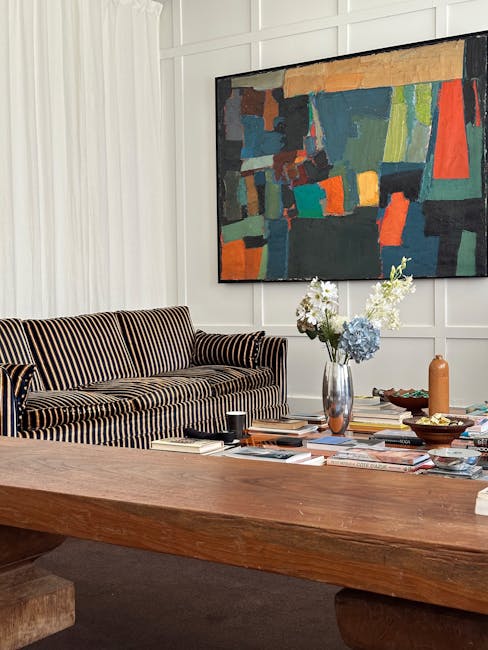
I visited the studio on a grey Melbourne morning. The front room had been renovated again (Flack does this constantly; he says “It’s always a testing ground”). The space felt like a thesis made physical: ochre walls, a salmon-pink sofa, an Akari paper lamp, a violent blue abstract painting leaning against a walnut credenza. Everything looked deliberate and accidental at the same time.
“I don’t like things matching,” he told me. “It feels weird.”
A cubbyhouse in Bendigo
Flack grew up in Bendigo, the son of a builder. He was twelve when he decided he wanted to be an interior designer. This is the kind of clean narrative detail that biographers love, but the real origin story is more specific. He built a cubbyhouse in the backyard. Three metres by three metres, two windows and a door. His father installed air conditioning.
“I was always an outcast as a kid,” he says. “I was obviously queer from birth, so I didn’t necessarily ever find my world. I was just creating worlds for myself in hindsight. Looking back as an adult, that’s a really beautiful thing.”
He moved to Melbourne at nineteen. I keep coming back to this age. Nineteen is young enough to be terrified and old enough to pretend you are not. The transition was harder than he expected. He dropped out of design school after the first year, overwhelmed by the scale of the city, and spent three years studying business marketing before going back to finish his degree at Swinburne. “I would say my life started at nineteen when I moved to the city,” he says. “I found my people. I felt very comfortable in my own skin. I knew who I was.”
His first industry job was at Hecker Phelan Guthrie, where he started as a rouseabout. The office term for whoever does whatever needs doing. He followed his mentor Kerry Phelan when she founded her own practice, KDPO, and worked there for four and a half years. London beckoned after that; he had plans to work with British designer Ilse Crawford. But a series of small commissions kept him in Melbourne. A butcher shop fit out. A friend’s terrace house in East Melbourne. Each job led to the next through what he calls the “eternal whisperers of the industry.” Suppliers, trades, word of mouth.
I think about this part of his story often. There is a version of this career where the London move happens and the trajectory is totally different. But the small jobs kept him here, and those small jobs became the foundation. A butcher shop becomes a house becomes a hotel. The scaling is organic. It never feels like it was strategised.
The moment it changed
Flack Studio was founded in 2014. For the first three years, it was essentially a solo operation. The turning point came in 2017, when Flack secured the lease on a Fitzroy storefront and decided to make it a shared space. “When we got that studio, we were like, actually, this space is amazing. Let’s share it with people,” he says. “The studio was quintessentially always going to be about me and our community and who we work with.”
The same year, the studio won the Ace Hotel Sydney project. It was a commission that would define the practice. “The Ace was literally life-changing personally and professionally,” Flack says. “It was the biggest thing ever, the hardest thing ever.” The hotel occupies a former brick building in Surry Hills, and Flack approached it with what he calls “residential thinking applied to hospitality.” He imagined it as a share house with a sunken lounge. Ochre carpet. Solid timber. Albert Namatjira’s desert landscapes as the colour reference.
“Hotels always look like hotels,” he says. “I wanted this to feel like a big share house in Surry Hills.”
Troye Sivan and the 10-million-view moment
The project that introduced Flack to a global audience was not a hotel but a home. In 2021, Architectural Digest filmed a tour of the Melbourne house he designed for pop star Troye Sivan. The video has since been viewed more than ten million times. You have probably seen it even if you do not remember the name. The kitchen with the Maker and Son sofa. The vintage Moroccan rug. The pool with bleachers inspired by Fitzroy’s public swimming pool.
“People say we are famous because of Troye Sivan, but I am like, not really,” Flack laughs. Still, he acknowledges the project changed the trajectory of the studio. “It is so relaxed. You can immediately place yourself in that room.” The natural materials, he says, pair well with the mix of new and old furniture. “There is an element of substance that vintage brings. There is nothing overly intellectual about it. It is just a feeling.”
He designed a second home for Sivan in Los Angeles, a restoration of a John Mockridge designed house that the singer wanted brought back to its modernist origins. When the Mockridge Foundation sent a handwritten letter saying the architect “would have loved what we did,” Flack cried.
The materials in the room
Flack talks about interiors the way a musician might talk about an orchestra. Materials, he says, “sing and dance together.” Early in his career, he produced monochromatic interiors. Safe, tonal schemes that pleased clients but bored him. Then he started “throwing crazy combinations together” and noticed they kept landing. A bathroom in apple green stone with an Ettore Sottsass inspired sink. A kitchen where Milan meets Mexico: aged brass overhead, handmade Portuguese tiles, rhodium quartzite island bench, four types of metal hardware.
“Everything speaks to each other confidently,” he told The Guardian. The key word there is confidently. These are not random collisions. They are juxtapositions where each material understands its role.
The result is not maximalism in the traditional sense, not the kind where everything competes for your attention. It is something more considered. Each material earns its place through contrast. The roughness of raw concrete next to the warmth of walnut. The precision of aged brass against the irregularity of handmade tile. It looks thrown together but it is not.
To work with Flack is to answer a strange question early on. He does not ask about budgets or timelines or square metres. He asks how you want to feel. Whether you put a record on when you walk through the door. Whether you are messy or tidy. “You are expressing yourself through someone else,” he says of his role. “Knowing when it is right is always a gut instinct.”
“Being true to yourself and allowing that level of authenticity unlocks your creativity,” he told Galerie Magazine. It sounds like a line from a commencement speech until you see the work. Then you understand he means it literally. Each room is a portrait of the person who lives there, refracted through his particular lens.
This is perhaps the most disarming thing about working with him. You arrive expecting to discuss joinery and bench heights and you leave having described the feeling of a room you did not know you needed. The technical work happens underneath.
The early jobs were safe because that was what clients wanted. He earned the trust, project by project, to push the palette further and further. Now the clients come to him expecting colour and texture. The brief is already half written before he picks up a pencil.
If you are wondering where these principles sit within the broader shifts in Australian homes right now, I recently mapped the 2026 interior design trends for this site. Flack’s approach slots into something larger: a turn away from safe greige towards spaces that actually reflect the people living in them.
The studio now
Flack Studio today employs twenty-two people, including a dedicated architectural arm led by Richie Bligh. The team has worked on projects from Seoul to Los Angeles. The Seoul project was a coffee shop, a Caravan outpost that took his Fitzroy sensibility to a neighbourhood in Seoul. Texture and warmth, it turned out, translate just fine. The Los Angeles work included the Troye Sivan restoration and private homes that have not been published yet.
In 2025, Rizzoli published “Flack Studio: Interiors.” 264 pages, 180 Australian dollars, with a foreword by Architectural Digest’s global editorial director and photography by Anson Smart. The book was Flack’s attempt to frame the work from the client’s perspective. “Interiors are alive,” he says. “They can change your life.”
The studio also launched a lighting collection with Brunswick East based Volker Haug Studio, shown at Salone del Mobile in Milan. The Me and You collection (lamps, sconces, pendants in powder-coated steel, glass, fibreglass, cast aluminium and brass) is the kind of partnership Flack says “spawned out of nothing” and “was pure fun.”
I asked him what he thought about “flackifying” becoming a decorating verb. He laughed. He had not heard that one. But he seemed pleased, in a way that suggested he might not admit it.
“The more I travel, the more I engage with people, and it starts reflecting in the work,” he says. “For me, the evolution is now about the studio as a collective, not just me.”
He is forty years old now, twenty-eight years removed from that Bendigo cubbyhouse with the air conditioner, and still building worlds. The difference is that now the worlds belong to other people, and he has gotten very good at listening to what they need them to be. It is a strange kind of success: becoming so distinctive that your name enters the language, then spending your energy turning the attention away from yourself and back onto the people you design for.
Lila Beaumont
Sydney inner-west design editor with a soft spot for honest materials, sun-bleached palettes and homes that age well. Ex-Real Living.